

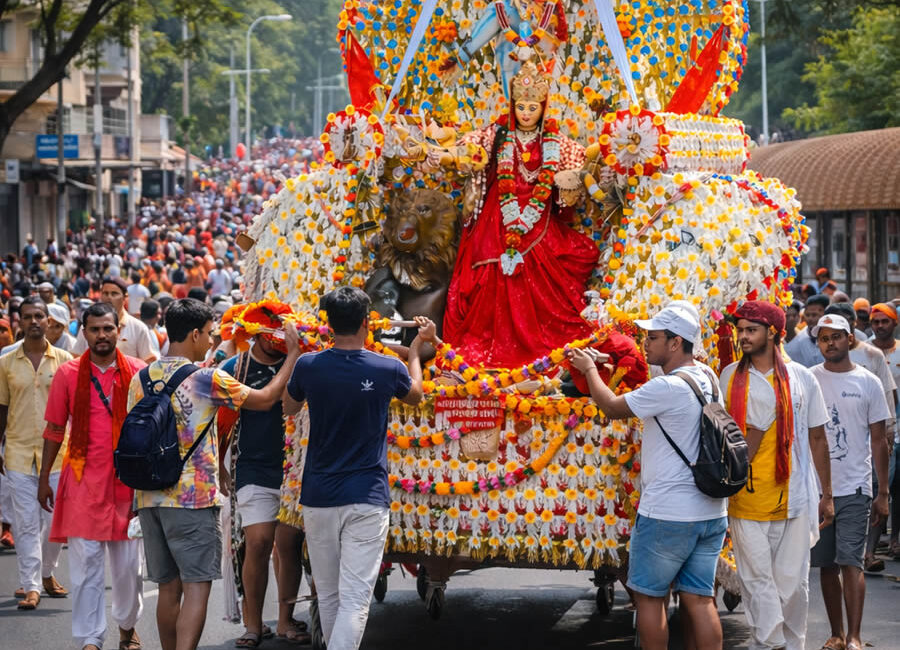


There are periods in the year when Mauritius feels slightly different. Not in a way that stops daily life, but enough to be noticed. Roads can be busier in certain areas, routines shift, and people move with a sense of purpose connected to events that matter to them. For visitors, this can be one of the most revealing times to be on the island.
These moments are not organised as festivals for tourists. They are part of everyday Mauritian life, and they happen whether visitors are there or not. Experiencing them usually means noticing small changes rather than attending anything formal.
Mahashivratri is often the most immediately visible. In the days leading up to it, people walk towards Grand Bassin, a lake in the south-west of the island that holds deep meaning for the Hindu community. Pilgrims set off from different regions, sometimes walking for several days, carrying decorated kanwars and moving steadily along the roads.
Travellers usually come across this in practical ways. Traffic slows, certain routes take longer, and it becomes common to see groups of people walking together early in the morning or late into the evening. The atmosphere is focused and organised, and the pilgrimage is widely respected across the island. At Grand Bassin, the area becomes busy, but remains calm. Visitors are welcome to look around, provided they dress modestly and behave with discretion.
Around the same time, Chinese New Year brings a different energy, especially in Port Louis. This is an important moment for the Sino-Mauritian community and is centred around family and the start of a new year. In the days beforehand, decorations appear in shop windows, temples become more active and certain neighbourhoods feel livelier.
On the day itself, there may be fireworks and, in some areas, lion dances. Restaurants can be busier than usual, and some businesses close for part of the day. For most visitors, Chinese New Year is something they notice as they move through the city, rather than an event they plan around.
National Independence Day, on 12 March, is marked more quietly. There are official ceremonies and flags are displayed, but for most people it is a day of recognition rather than celebration. Some offices close and traffic can be affected near formal events, particularly in the capital.
Eid follows its own rhythm. It marks the end of Ramadan for the Muslim community and is largely focused on family, prayer and time at home. Mosques are busy in the morning, and the rest of the day is generally low-key in public spaces. Visitors might notice adjusted opening hours or fuller restaurants in the evening.
What often stands out to travellers is how all of this happens side by side. None of these moments stop the island completely, and none exist in isolation. Beaches remain open, hotels continue as normal, and everyday life adapts rather than pauses.
From a visitor’s point of view, being in Mauritius at this time simply requires a little patience and awareness. Allowing extra time to get around and being mindful of what is happening locally is usually enough. In return, travellers get a clearer sense of how the island works beyond its tourist image.
For many people, these quieter observations become some of the most memorable parts of a trip. They offer a view of Mauritius as a lived-in country, shaped by different histories and traditions, shared without fuss and without spectacle.